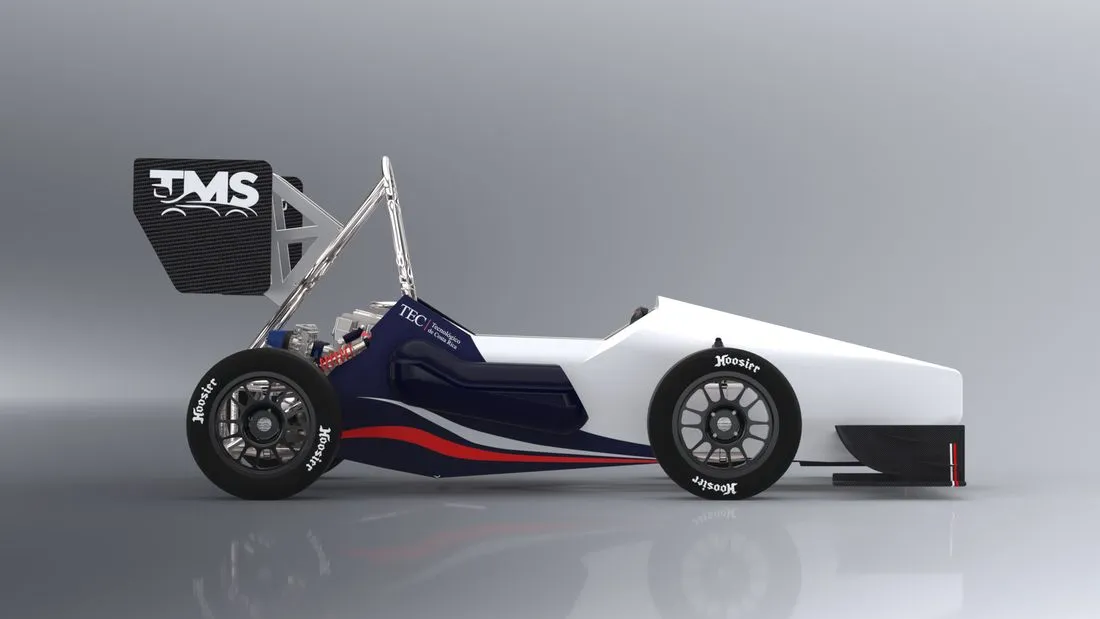
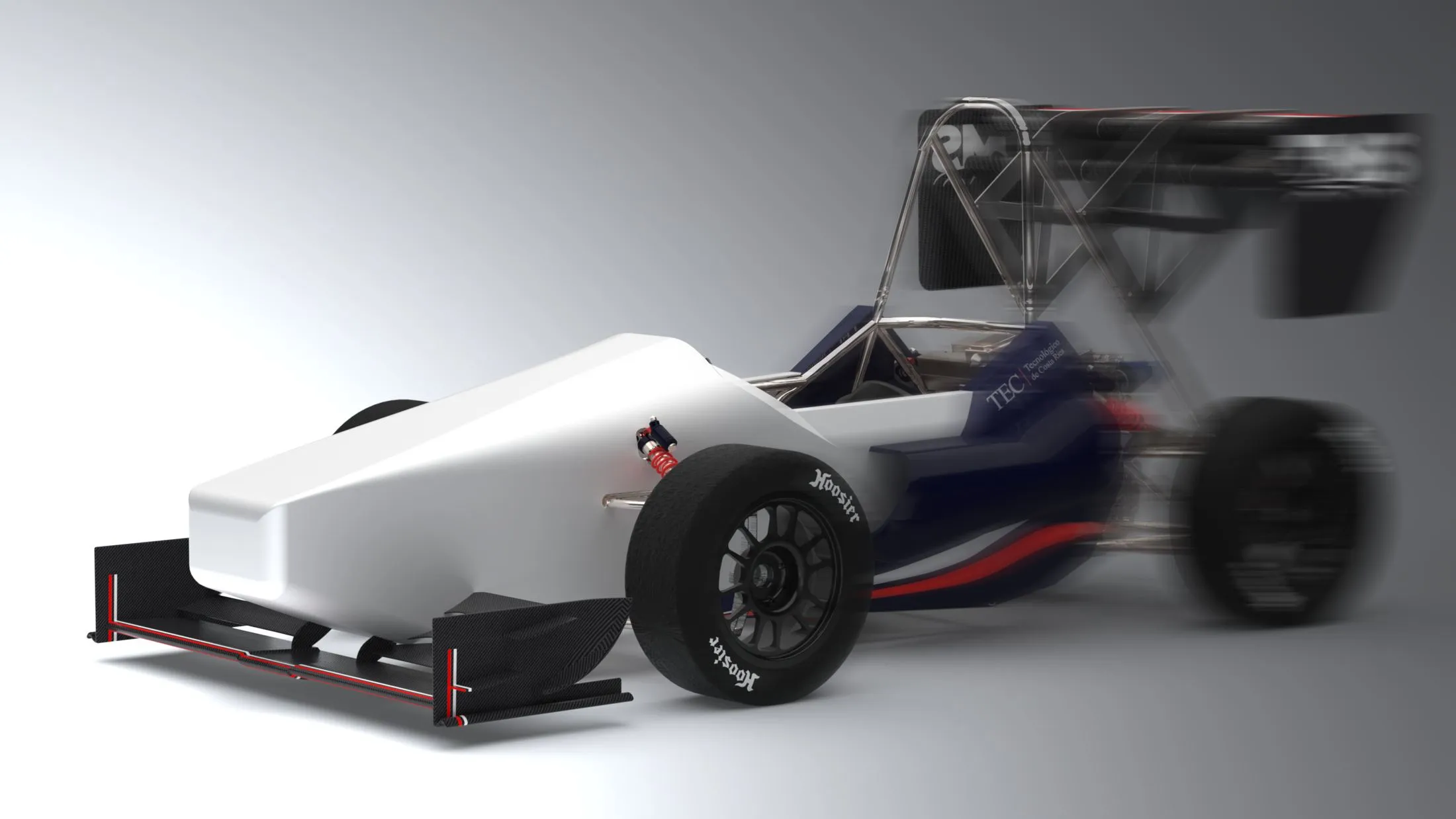
Formula SAE Michigan 2027

The competition

May 12–15, 2027, at Michigan International Speedway. Here is what lies ahead.

What is Formula SAE?

An engineering education competition. Teams of university students conceive, design, fabricate, develop and compete with a small formula-style car.

Each team works like an engineering firm building a prototype. Besides performance, aesthetics, cost, ergonomics, maintainability and manufacturability all count.

Rules GR.1.2 · GR.1.3 · GR.1.4

Two classes

The rules for each car depend on its powertrain.

ICOurs

Internal combustion

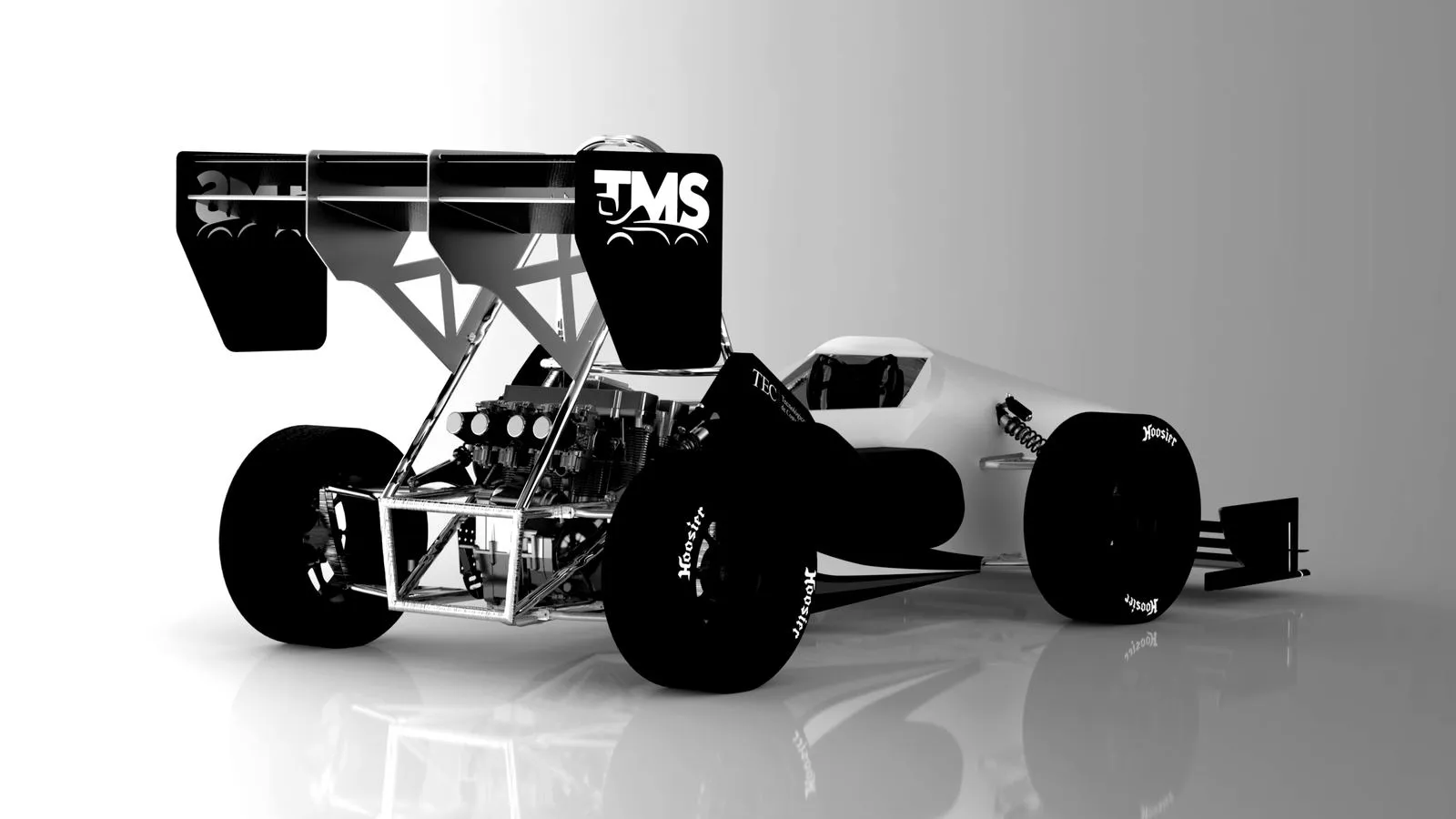
Car 80 · Honda 500 cc

  • Four-stroke piston engine.Rule IC.1.1.1
  • Maximum displacement of 710 cc.Rule IC.1.1.1
  • All intake air passes through a circular restrictor: 20 mm on gasoline, 19 mm on E85.Rules IC.2.4.1 · IC.2.4.3
  • Hybrid powertrains are not allowed.Rule IC.1.1.2
EV

Electric

  • Electric motors only, in any number.Rule EV.4.1.1
  • Maximum power of 80 kW.Rule EV.3.3.1
  • Maximum voltage of 600 V DC.Rule EV.3.3.2
  • The motor may not drive the car in reverse.Rule EV.3.1.1

1000 points at stake

They are split between static and dynamic events. Tap an event to see what it is about.

Static events

Off the track, in front of judges. Rule S.1

Presentation75 pts

The team presents a business, logistics, production or technical case to convince outside investors. Judges come from different fields and are not all engineers.

Rules S.2.1 · S.2.2.5
Cost and manufacturing100 pts

Judges the budget and how the car would be produced. The team submits a report that lists and costs every part, then discusses it with the judges at the car.

Rules S.3.1 · S.3.4.1
Design150 pts

Judges review the engineering effort and how well the team understands its design. Teams lose points if they cannot explain how the car was engineered and built.

Rules S.4.1 · S.4.9.1

Dynamic events

On track, against the clock. Rule D.1.1

Acceleration100 pts

A 75 m straight on flat pavement. Each team gets up to four runs with two drivers.

Rules D.9.1.1 · D.9.2.1
Skidpad75 pts

A figure eight made of two pairs of circles; the inner ones are 15.25 m across. It measures how the car corners on a constant radius.

Rules D.10.1.1 · D.10.2.3
Autocross125 pts

A tight course of about 0.8 km with turns, slaloms and hairpins, averaging 40 to 48 km/h. Its results set the Endurance run order.

Rules D.11.1.1 · D.12.3.1
Endurance275 pts

About 22 km of laps with two drivers and a driver change halfway. It tests performance, durability and reliability: once it starts, no one may work on the car.

Rules D.12.1.3 · D.12.1.4 · D.12.2.1
Efficiency100 pts

Measures the fuel the car uses during Endurance, together with its lap time.

Rules D.13 · D.13.1.1

Before racing

Without passing technical inspection, the car cannot enter any dynamic event. Rules IN.1.1 · IN.3.1

  1. 1

    Initial inspection

    Each driver's gear, fire extinguishers and wet tires.

    Rule IN.4
  2. 2

    Vehicle inspection

    Cockpit templates and the egress test: each driver gets out in 5 seconds or less.

    Rules IN.6 · IN.9.2.1
  3. 3

    Tilt test

    At 45° no fluid may leak. At 60° the car must not roll over.

    Rule IN.11.2
  4. 4

    Noise test

    110 dBC maximum, 103 dBC at idle.

    Rule IN.12.5
  5. 5

    Brake test

    At the end of an acceleration run, all four wheels lock and the engine keeps running.

    Rule IN.14.2.2

Key requirements

What the rules ask of the team.

  • Built by students

    Students conceive, design, build and maintain the car. Professionals may share information but may not make design decisions or drawings.

    Rules GR.9.1.1 · GR.9.1.3
  • Enrolled students

    Every member is enrolled in an undergraduate or graduate degree at their university. Those who graduated in the previous seven months may still take part.

    Rules AD.3.1.1 · AD.3.1.2
  • 18 or older

    All team members must be at least 18 years old.

    Rule AD.3.2
  • Licensed drivers

    Anyone who drives needs a valid, government-issued driver's license.

    Rule AD.3.3
  • At least four drivers

    Each driver may run at most three events, so four are needed to cover every dynamic event.

    Rule D.7.1
  • Faculty advisor

    Appointed by the university. The advisor may give advice but may not design, build or repair the car.

    Rules AD.5.1.1 · AD.5.1.3
  • A new car

    Only first-year vehicles, with a newly built chassis, may compete.

    Rules GR.9.2.2 · GR.9.3.1
  • SAE members

    Every member belongs to SAE International and shows proof at registration.

    Rule AD.3.4
  • In English

    English is the official language of the series: documents, presentations and talks with judges.

    Rule AD.1.3

Fun facts

  • 20 mmMaximum air restrictor diameter on gasoline.Rule IC.2.4.3
  • 5 sThe longest a driver may take to get out of the car.Rule IN.9.2.1
  • 60°Tilt angle at which the car must not roll over.Rule IN.11.2.2
  • 1525 mmMinimum wheelbase.Rule V.1.2
  • 3 minTime allowed for the Endurance driver change.Rule D.12.8.2
  • 105 km/hApproximate top speed on the Endurance course.Rule D.12.2.2
  • 0Additives allowed in engine cooling water: plain water only.Rule T.5.4.1
  • 2Fire extinguishers at least: one in the paddock, one with the car.Rule VE.2.3.1

Source

Formula SAE® Rules 2027. Version 1.0, 1 September 2026. SAE International.

Every fact on this page comes from the official rules, with its rule number. The rules can change; the current version is on the Formula SAE website.

Go to fsaeonline.com (opens in a new tab)

From Costa Ricato Michigan

—days to competition

From May 12 to 15, 2027, we take car 80 to Michigan International Speedway. Costa Rican engineering, built by students.